Shirodhara: The Therapy for Sleep That Never Came Back After Altitude
You came down four days ago and you are still waking at 3am. That is not in your head, and it is the single most common thing we treat between October and December.
What Shirodhara physically is
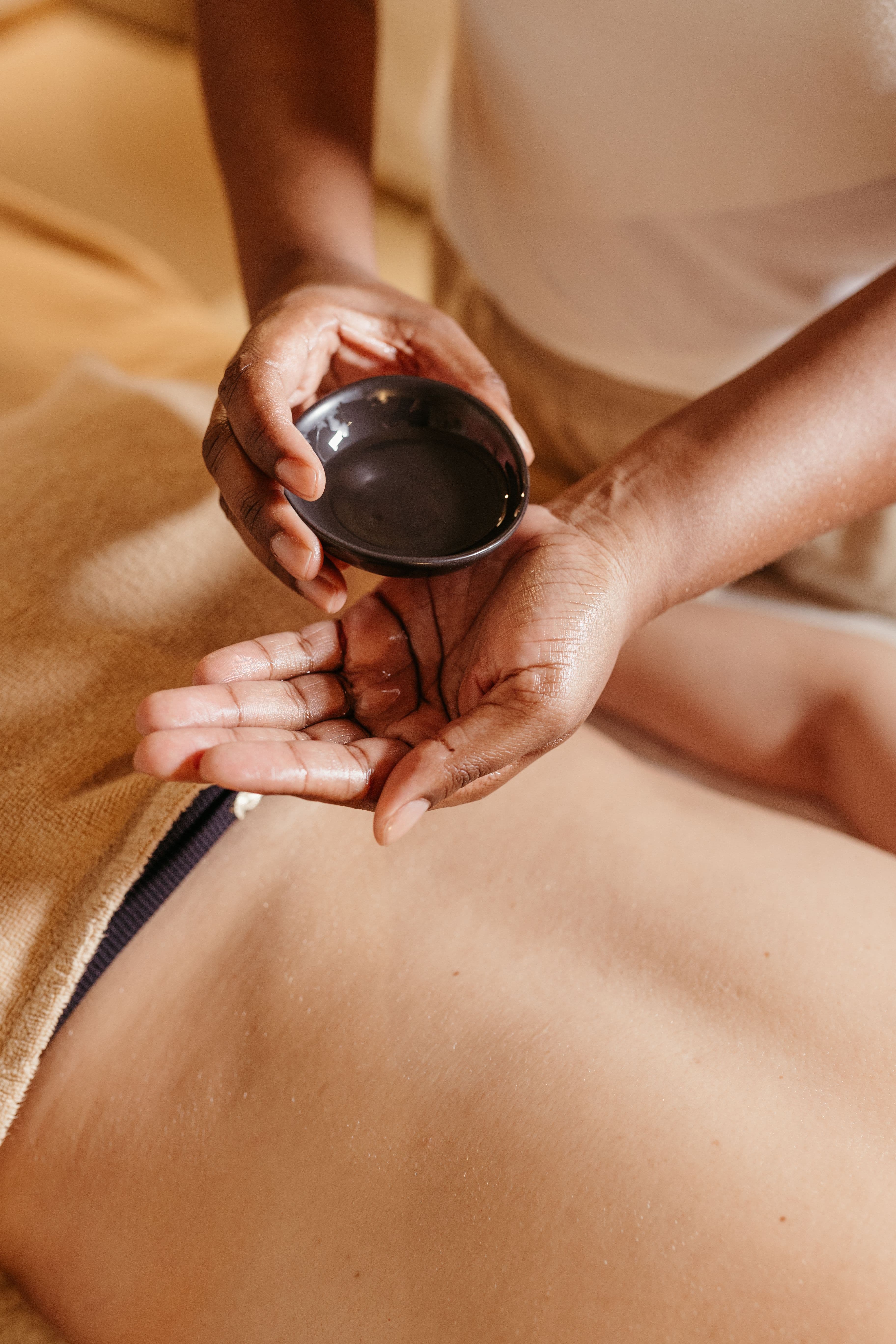
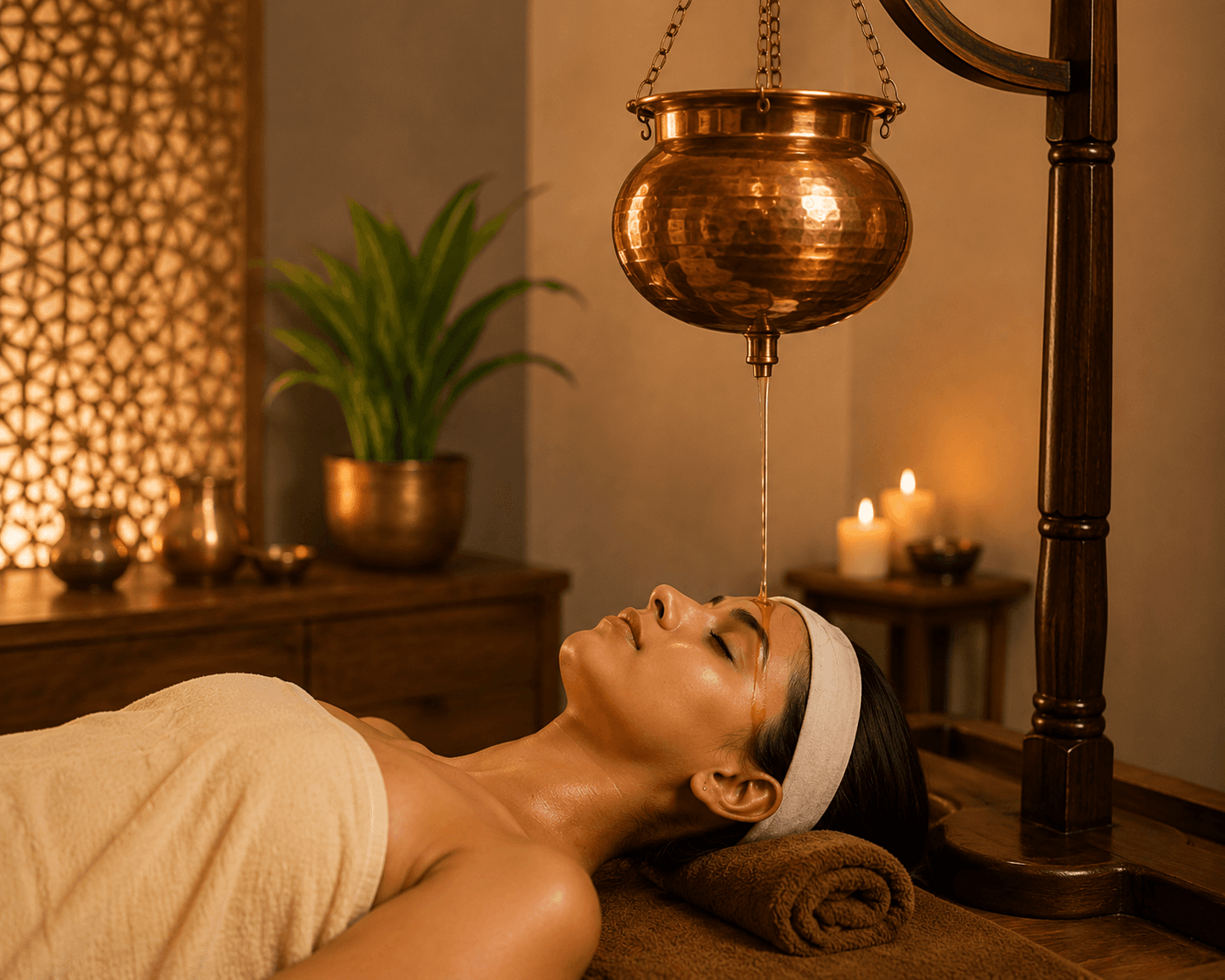
A continuous stream of warm herbal oil poured onto the forehead from a suspended vessel, moving slowly across the brow in a steady rhythm for thirty to forty-five minutes. The oil is caught, rewarmed and recirculated. There is a short head and shoulder release before it starts and a period of silence afterwards that is part of the treatment rather than a courtesy.
That is the entire mechanism. Nothing is inserted, ingested or manipulated. It is warmth, weight, sound and monotony applied to the most densely innervated part of the body.
Why altitude sleep does not fix itself the day you descend
Above roughly 3,000 metres, most people develop periodic breathing during sleep — the breath cycles between deep and shallow, with pauses, and each pause produces a micro-arousal. You may not remember waking, but the deep-sleep architecture is broken up for as long as you are high, and the higher camps of the Annapurna routes guarantee it.
Layer on cortisol from ten hours of daily exertion, dehydration that has been quietly accumulating for a fortnight, cold, and the fact that you have been in bed at 7pm and awake at 5am for two weeks. Your circadian rhythm and your stress axis have both been shifted, and neither snaps back because you are now sitting beside Phewa Lake with a beer.
In practice, people report broken sleep for one to three weeks after descent. That is normal, and it is also treatable.
What the oil stream is actually doing
The forehead and scalp carry an unusually high density of sensory receptors. A stimulus that is warm, constant, low-intensity and completely predictable gives that system nothing to track — and a nervous system with nothing to track downshifts. The measurable version of this is a shift towards parasympathetic dominance: slower breath, lower heart rate, warmer extremities.
In Ayurvedic terms Shirodhara is the classical treatment for aggravated Vata affecting the head — the pattern of dryness, cold, irregularity, racing thought and light broken sleep. Post-trek is close to a textbook description of that pattern, which is why the therapy suits the situation so precisely.
The honest caveat: the clinical research on Shirodhara is small-scale and the trials that exist are modest. What we can say with confidence is what we observe several times a day in October — people fall asleep on the table, and most report their first full night that night.
What the session feels like
- First ten minutes. Head, neck and shoulders are worked to release the muscles that would otherwise resist lying still. Most of the noticeable pressure in the whole treatment happens here.
- The stream begins. Warm oil on the forehead is a strange sensation for about ninety seconds, then it stops registering as an event and becomes background.
- Minutes ten to thirty. The most common report is losing track of time entirely — not asleep, not awake. Some people cry, some talk, most go quiet. All three are ordinary and none of them need explaining afterwards.
- The end. The stream stops, the oil is left in the hair, and you rest. Getting up immediately undoes a good part of the effect, so we leave you.
- Afterwards. You leave with oiled hair. Bring a scarf or a hat if that bothers you, and do not plan anything social for the evening.
Who should not have it
- Anyone with a fever, an acute infection or a headache that started at altitude and has not been assessed.
- Anyone who has been drinking that day, which is a real consideration on a Lakeside evening.
- Anyone with an open wound, recent head or neck injury, or a scalp infection.
- First trimester of pregnancy, or a high-risk pregnancy without written clearance.
- Anyone with a diagnosed cerebrovascular condition, without their doctor's sign-off.
- On a completely empty stomach — eat something light two hours before or you will feel faint on standing.
One session or a course?
For post-trek sleep disruption, one session frequently does the job, because you are correcting a temporary disturbance in an otherwise functional system. Book it for early evening and go straight back to your room afterwards.
For chronic insomnia, anxiety or burnout that predates your holiday, one session is a pleasant experience and not a treatment. The classical course is seven consecutive days, and the difference between one and seven is not marginal — it is the difference between a good night and a reset. If you live in Pokhara, that course is worth planning properly rather than improvising.
Practical timing for trekkers
Do not book Shirodhara for the same slot as deep recovery work if you can avoid it. Deep tissue work leaves the nervous system stimulated for a couple of hours; Shirodhara is trying to do the opposite. If you want both in one visit, deep work first with a long gap, or better, deep work on the day you arrive and Shirodhara the following evening.
And leave it off the day you travel. Arriving at the airport or the tourist bus park with oil in your hair and a half-sedated nervous system is nobody's best plan.
Last updated .
Written by
Dr. Sushmita Bhattarai
Clinical Director
BAMS (Bachelor of Ayurvedic Medicine & Surgery), NAMC registered · 16 years in practice.
Shirodhara details & pricing
45 or 60 minutes, NPR 4,000, with dosha-matched oil and a quiet room. Evening slots suit it best.